Showing posts with label cooking with herbs. Show all posts

Monday, June 7, 2010

Something fishy going on

It is a family tradition that if you are at home for your birthday, you get to choose what we have for dinner. Amita is predictable as his favourite meal in the whole world is fondue. He likes to eat it in the traditional Swiss way, simply bread and cheese. After cracking two ceramic fondue pots, one birthday I bought him -  a smaller Le Creuset (son of the blue pot)   that fits perfectly on the burner.

I threaten to fall into a swoon if I can’t eat something green at every meal and contaminating the fondue with any vegetable, except possibly potatoes, is frowned upon. The other serious problem is inviting guests for a fondue as he loathes sharing it. So that is one: an unhappy cook (not recommended) and two: guests duelling with fondue forks over a hot pot (also not recommended.)

After some delicate negotiation, he decided to choose something else – Bouillabaisse, a traditional fisherman’s soup from the Mediterranean cooked in one pot. I had never cooked it before and dived into Elizabeth David who in two and a half pages of text, gave stern warnings about not overcooking the different seafood but no indications of specifics. I eventually found a recipe from a well known chef on the internet and set off to buy about a million dollars worth of seafood. When I began to follow the recipe, I realised it had been posted without checking and was very hard to follow

At least I already had the pot and as we have been having cold nights, the wood stove is lit every evening and is perfect for a long slow simmer.

A good fish stock is absolutely critical to a good bouillabaisse and is expensive to buy as it comes in 375ml containers.
This is my version:


Fantastic Fish Stock

1 onion, roughly chopped
1 carrot, thinly sliced
1 stalk of celery, leaves included, finely sliced
1 leek, thinly sliced
3 cloves of garlic, roughly chopped
One wing of barramundi, a large fish head, some prawn heads, whole cleaned fish or a combination of what you have.
A whole fish, head on, cleaned and chopped up roughly (I used perch)
3 large tomatoes, diced
2 Tbsp tomato paste
2 handfuls of flat leaf parsley
2 bay leaves
1 orange, zested (with a peeler into strips) and juiced
1 lemon, zested (ditto) and juiced
½ C olive oil
1 tsp black peppercorns

Sauté the vegetables, except the tomatoes, in the olive oil over a medium heat until they begin to colour.
Add the fish and brown.
Add the tomatoes, bay leaves, orange, lemon and parsley and cook till softened then add the tomato paste.
Cover with water, bring to the boil and simmer for a minimum of two hours or longer. If cooking the stock over a couple of days, make sure that it is bought to a rolling boil each time before reducing the heat to a simmer.
If you are making soup, leave the lid on to retain the maximum flavour. If you want to freeze it, you can reduce it by simmering without a lid after straining.
Strain through a sieve and add salt to taste.
Freeze in 500ml containers until required.

Happy cooking,

nirala

Ps. The soup was amazing. I dished it up before bringing to the table so we managed to avoid any disagreements over the number of prawns and mussels and other tasty bits in each bowl. I was far too busy to take a photograph of the finished dish!

Monday, January 4, 2010

Summertime

Today is the first day of the return to some sort of reality as the limbo of the week between Christmas and New Year ends. Shops, banks and the Post office will be open ‘normal’ hours all week and hopefully we will be able to stop asking each other what day it is. Living in a tourist town it is often hard to focus on work when the rest of the world is on holiday but the demands of animals, gardens and harvest keep me somewhat grounded in the practical.

Christmas is the time of year that the St John’s Wort flowers here. Some of the most prolific patches grow on the damp verges of the road to Summertime farm (the same road pictured above). This year the crop flowered early and I harvested a bag of flowers the week before Christmas. Hypericum perforatum is an introduced weed of excellent medicinal properties. Analgesic, anti-inflammatory, antiseptic, antiviral and antibacterial, it has been used To soothe wounds, burns and bruising, ease fibrositis, sciatica, arthritis, rheumatism and gout and to help relieve depression.Last year Nerys and I made extractions into oil and Nerys has posted a blog on this wonderful process that saw yellow flowers gradually turn the oil a miraculous deep red.http://gypsysoul-au.blogspot.com/2009/01/little-bit-of-magic.html and http://gypsysoul-au.blogspot.com/2009/01/st-johns-wort-oil.html This year she asked me to make her a tincture.

Here is the method:

Fill a glass jar with flowers, after the spiders have had a chance to run away.

Cover with the highest proof alcohol you can buy (I use vodka but you can use brandy or gin.)

Label the jar with the date you start and the date the tincture will be ready (10 – 14 days.)
Each day tap the base of the jar 100 times ( or for one minute) onto either the heel of your hand or a folded cloth. This is known as ‘succussion’ and is a process that allows the release of the plants properties into the alcohol.

After 10 days – 2 weeks, strain the tincture first through a sieve and then through a paper coffee filter into a brown bottle to protect from the light. 5 ml of glycerine added to each 250ml of tincture will increase its keeping properties.

Label and store in a cool dark place.

Dosage is 5-15 drops in 40ml of water three times a day.

Do not give tinctures to children under five.

More information on herbal tinctures is available in 'Healing with Herbs,' click on the cover in the side bar.

The particular magic of making this tincture was that it turned red before our eyes. As the weather became very hot, I decided to strain it after 10 days.By the way, be careful, the red tincture created black stains on my white shirt, which then spookily turn yellow in the wash!

May the New Year bring you joy and inspiration,

nirala

Wednesday, July 29, 2009

Brightening Wash Day Blues

I know this idea has come up before, but with so many of us consigned to a 1/4 acre or less suburban block these days, ideas for turning small spaces into productive spaces are necessary when we want to turn our hand to being a little more self-sufficient.

It is amazing what can be achieved by using wasted spaces, such as beneath the clothesline.With the growth of apartment living, and the suburban backyard shrinking, a lot of people find they no longer can use a clothesline to dry their clothes, but for those of us who still have the rotary hoist in the back, that space beneath it can be made useful.

I remember reading how in the past "ladies of the house" would grow lavender bushes next to the clothesline for draping handkerchiefs and "smalls" over to impart a lovely fragrance while they dried. Apparently it was also planted where the bed sheets could brush against the lavender while they were on the line, giving them a natural insect repellence during storage.

Mark a line about 1.5 metres out from the clothesline pole, giving you a garden diameter of 3 metres. Remember to leave an opening to walk through to get to your line! You can plant the lavender any way you like - if the soil is easy enough to dig, go straight in! If it's rocky or hard, you may want to raise a bed. Place the plants just in from your marked line. Unless your area is damp and shady, you should be able to find a lavender to suit almost any climate.

Directly around the pole, you can also add another bed about 50 centimetres out from the pole all the way around, to give a smaller bed with a diameter of 1 metre. This is a neat little bed that can be reached over easily, and it can be used to plant any number of different plants; I've seen both sweet peas and climbing beans trained up a climbing frame around the pole, with nasturtiums planted beneath. My neighbour at my old place had cherry tomatoes, but I decided to plant rosemary in mine.

I didn't think I would ever miss a clothesline! There ought to be enough distance between the two beds to walk between, and to hang long things, which will still brush against the plants in a breeze.If you're allergic to bees, it may pay you to choose plants that are not quite so attractive to them, or you could prune your lavender hedge more regularly so that it doesn't come into flower, but you can still enjoy the fragrant foliage.

There's also no reason to stick to just lavender either. Many of the scented-leaf pelargonium are suited, and they come in such scents as lemon, lime, citronella, rose, cinnamon, nutmeg, apple and violet! Curry plant is also wonderfully scented (Helichrysum italicum). If your clothesline is shaded, why not try some mint? Suitably restrained of course.

Don't feel limited to the hedging idea, either. Some of the magnificent groundcover thymes would be fabulous.Place an old table or bench near your garden "entrance" to hold a basket of laundry, and a painted terracotta pot to hold the pegs. Hanging the wash isn't anyone favourite task, but if it's got to be done - which it has :P - why not make it as pleasant as possible?

You may even want to sit a while, once the job is done :
Kerry Monteith

Thank you so much for this article Kerry and if anyone creates a garden such as this one we'd really love a photo please.

Sunday, June 28, 2009

Lion in a Teacup

Since reading Barbara Kingsolver’s book ‘Animal Vegetable, Miracle’ last year, I have become increasingly aware of the ‘food miles’ that are logged up on some of the items I regularly stock in my pantry. The book is the story of her family’s first year of committing to eating only what they can grow themselves or source locally. They allowed themselves one luxury item each, to be sourced through Fair Trade organizations. Barbara chose spices, her husband coffee. I can relate to both those choices. I hoard my Dutch cinnamon like a miser and often take its lid off so I can inhale the warm spiciness. My naturopath, a confessed coffee addict herself, advised me recently that I should give up coffee as part of a detox diet. The first few days were not pretty but I rediscovered a blend of dandelion and chicory root at the local health food store that mimicked the flavour enough for me to pretend it was the real thing. It is a good product but expensive and imported from Europe.

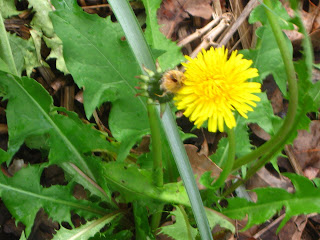
English dandelion (Taraxacum officinale) has been encouraged to grow where ever it likes in my garden as a salad green and chicken feed. It is a valuable addition to any diet, containing more nutrients than any other herb, including more Vitamin A than carrots. It is a tonic useful for the liver and gall bladder. Its sappy white juice can be used to remove warts. I had dug a large patch out to make room for more vegetable beds and was busy chucking it to the chickens when I realised it had roots on that the chickens wouldn’t eat.

Trimming and washing the roots, I chopped them into even sized slices and laid them on the racks in my electric food dryer. When dry, they went onto a baking tray which I placed in the oven of my cooling slow combustion stove as I shut it down for the night. By morning the pieces were uniformly dark brown in colour and looked like the stuff in the jar.

The taste test was next. You need to simmer the root for 5 minutes before straining. It can be used a couple of times before loosing its flavour. While similar to the commercial product, mine was a little earthier and lacked the ‘roundness’ of flavour that the chicory root provides. Mixed half/half it was good. If I can beg some chicory root, I will try that next time.


If I chose to, I could drink lemongrass or mint tea all year round as they both grow well. Instead, I chose an interesting experiment to provide one jar of produce, with very little cost to the environment or myself. I will never be able to grow coffee, tea or enough dandelion root to supply my own needs but I feel I am a little more informed about the effect of my shopping choices in terms of the environment.


For more information on eating dandelion, see Cooking with Herbs e book by Nerys Purchon.